Why Your Hands Get Stiff at a Cold Home Desk — and 4 Fixes
Quick Answer: Hands get stiff at a cold desk because peripheral blood flow drops to conserve core temperature, which reduces tissue temperature in the fingers and forearms and makes tendons glide less easily. You then unconsciously type harder to compensate, which is where forearm ache comes from. The four fixes that work: raise the room to about 70 to 72°F or redirect the air vent, keep hands physically warm with fingerless gloves or a warm mug, take a 60-second movement break every half hour, and reduce the force your keyboard requires.
By mid-afternoon your fingers feel clumsy and your forearms are tight, and you assume it is the hours. Often it is the thermostat.

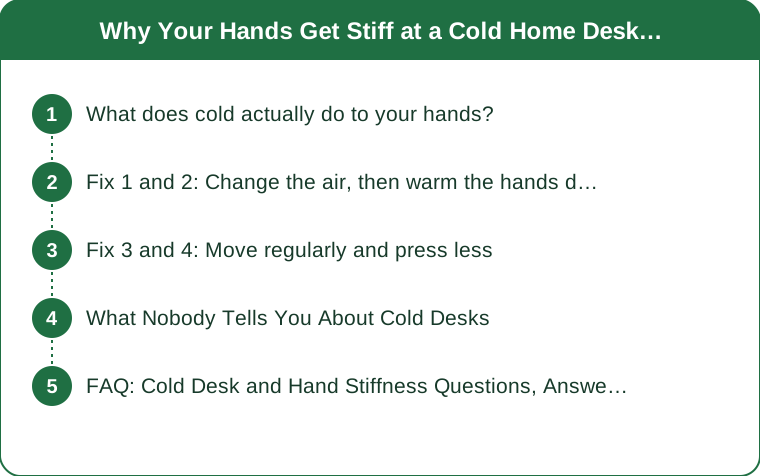
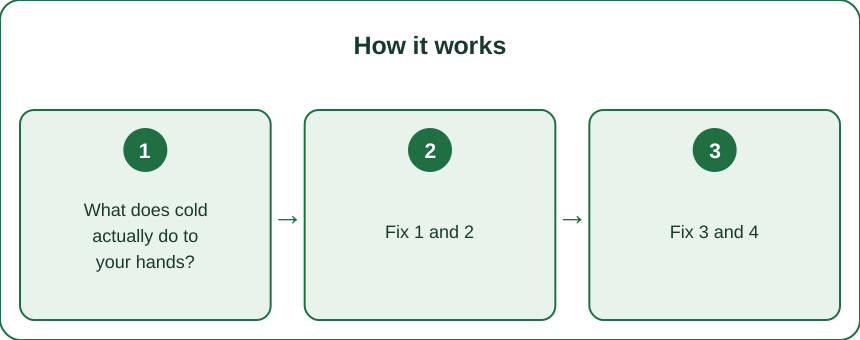
What does cold actually do to your hands?
Your body defends core temperature before anything else. When the surrounding air is cool, one of the first responses is peripheral vasoconstriction — narrowing the blood vessels in the hands and feet to reduce heat loss from the surface.
Less blood flow means lower tissue temperature in the fingers and forearms. Two things follow. Muscle contraction becomes less efficient at lower temperature, and tendons and their sheaths glide with more resistance, which is the stiffness you feel.
Nerve conduction also slows slightly in cool tissue, which is why fine motor accuracy drops and typos increase. Most people notice the typos before they notice the cold.
The important part is what happens next. Because your fingers feel less responsive, you press harder without deciding to. That extra force, repeated across thousands of keystrokes, is what turns a temperature problem into a forearm problem by 4 p.m.
Fix 1 and 2: Change the air, then warm the hands directly
Fix the air first. A home office in summer often sits at 66 to 68°F because the thermostat is set for a whole house or for someone who is more active. For seated desk work, 70 to 72°F is a far better target, since sitting still generates very little metabolic heat.
The second half of this is airflow. Direct air movement across your hands is worse than a cold room, because moving air strips heat continuously. If a vent or fan points at your desk, redirect it. A vent deflector costs almost nothing and is often the entire fix.
Then warm the hands directly. This is more effective than raising the room by several degrees and it is cheaper.
Fingerless compression gloves keep the hand and wrist warm while leaving fingertips free, and the light compression helps some people with stiffness independently. A warm mug held for 30 seconds between tasks does more than it sounds like it should — direct conductive warming reverses the vasoconstriction quickly. A small heated desk pad under the forearms is the quiet luxury option.

Fix 3 and 4: Move regularly and press less
Movement is what restores circulation, and it takes very little.
Every 30 minutes, do 60 seconds: open and close your fists 10 times, roll your wrists in both directions, then stretch the forearm by extending one arm and gently pulling the fingers back, 20 seconds per side. Stand up while you do it, because standing helps circulation everywhere.
The reason to do this on a schedule rather than when you notice stiffness is that the stiffness lags the circulation change by a long way. By the time your hands feel it, your forearms have been compensating for an hour.
Then reduce the force required. This is the fix people skip because it costs money, but the effect is large. A keyboard with lighter actuation force — a low-force mechanical switch or a good low-profile board — meaningfully reduces the work each keystroke takes.
Equally important and free: check your wrist angle. Wrists should be roughly flat or very slightly extended, floating rather than resting on a hard edge. A wrist bent up at 20 degrees against a desk edge compresses the same structures the cold is already restricting.
What Nobody Tells You About Cold Desks
Your feet drive your hands. Peripheral vasoconstriction is systemic, not local. Cold feet under a desk trigger the same conservation response that shuts down flow to your fingers. Warm socks or a small footrest away from the floor often fix hands more effectively than anything done to the hands.
Dehydration makes it noticeably worse. Lower blood volume means less peripheral perfusion, and air-conditioned rooms are dry, so people drink less than they think. A cold room is a room where you forget your water bottle.
Afternoon is worse for a physiological reason. Core temperature and circulation follow a daily rhythm, and combined with hours of stillness, the mid-afternoon window is genuinely your low point for peripheral warmth. It is not just fatigue.
Caffeine is mildly vasoconstrictive. Not a reason to skip it, but if your hands are already cold, the fourth cup is not helping the way you hope.
Persistent, dramatic color change is different. Fingers that go white or blue with cold and then red on rewarming, especially with pain, is a distinct pattern worth mentioning to a doctor rather than solving with gloves.
FAQ: Cold Desk and Hand Stiffness Questions, Answered
Is typing with cold hands actually harmful?
Cold itself does not cause injury, but the compensation does. Typing with more force than necessary, for hours, is a recognized contributor to forearm and wrist overuse problems. Removing the cold removes the reason to overpress.
Do compression gloves work or are they placebo?
The warmth is straightforwardly effective. The compression is more individual — some people find real relief from stiffness, others notice nothing. They are inexpensive enough to be worth trying.
How warm should the room actually be for desk work?
70 to 72°F suits most people for sedentary work, several degrees warmer than what feels right when you are moving around. If you share the space and cannot change it, warming hands and feet directly gets you most of the benefit.
Should I use a heating pad on my forearms?
A low-heat desk pad or heated mouse pad is fine and pleasant. Avoid anything hot enough to be uncomfortable, and do not use heat on an area that is actively painful or inflamed without checking with a professional first.
This is general information, not medical advice.
TL;DR:
- Cold triggers vasoconstriction, which lowers hand tissue temperature and makes tendons glide poorly.
- The real damage is the compensation: you press keys harder without noticing, and forearms pay for it.
- Target 70 to 72°F for seated work and redirect any vent or fan blowing across your desk.
- Warm hands directly with fingerless gloves, a warm mug, or a heated pad — and warm your feet, which drive the whole response.
- Take a 60-second movement break every 30 minutes and reduce keyboard force and wrist angle.
It is a strange thing to solve a hand problem with socks and a thermostat, but that is usually where it lives. Fix the temperature before you buy the ergonomic anything.
Keep Reading
This article is for general informational and styling purposes only. Fit, sizing, and product availability may vary.