Why the Work Day Expands to Fill Your Evening at Home
Quick Answer: An office day ends because of a physical transition — you pack up, leave, and travel. At home there is no transition, so the day has no ending signal, and work simply diffuses into the evening. The fix is to manufacture a transition: a defined shutdown sequence, a physical change of space, and a genuine hard stop that other people can see.
You closed the laptop at 5:30.
At 7:15 you replied to something. At 9:40 you opened a document to check one figure and were still there at 10:10.
None of it was urgent, none of it was asked for, and none of it felt like a decision. That is the point — nothing told you the day was over.
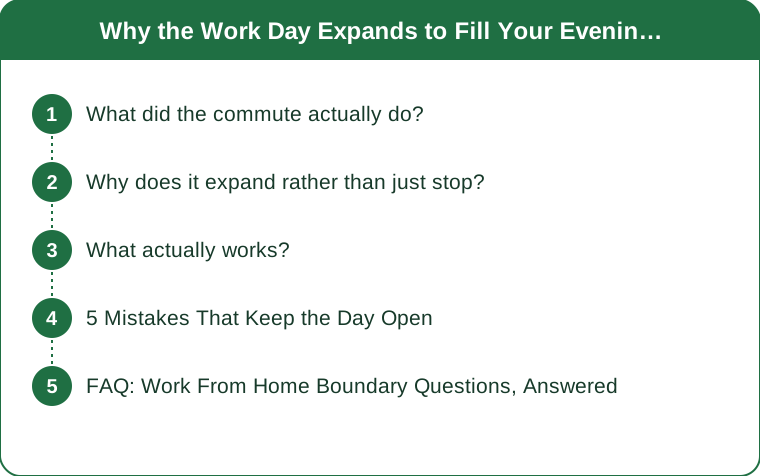
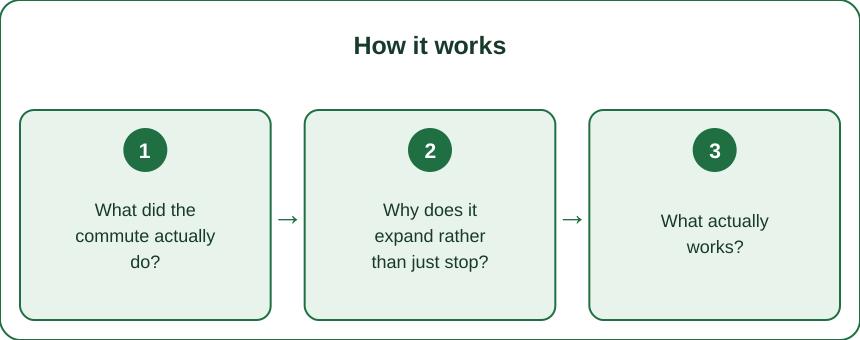
What did the commute actually do?
More than move you between buildings.
It provided a hard boundary. Leaving the building was an unambiguous event: you stopped, you were physically unable to continue, and everyone including you knew the day was over.
It provided a transition period. Twenty or forty minutes where you were neither working nor at home, which people reliably used to process the day, decompress, and mentally arrive somewhere else. Research on the commute has repeatedly found that people value this buffer even while disliking the commute itself.
It provided spatial separation. Work happened in a place you were not, which makes not-thinking-about-work considerably easier. At home the laptop is fifteen feet away all evening.
And it provided social closure — the visible act of people leaving, which signals collectively that the working day has an end.
Remove all four and the day has no shape. Work does not end; it just gets quieter, and it stays available.
Why does it expand rather than just stop?
Three forces, and none of them require a demanding boss.
Tasks have no natural end. Knowledge work is rarely finished — it is only put down. Without an external stop, the question becomes when do I feel done, and you never quite do. So you keep going a bit longer, most days.
Availability creates expectation. Answering something at 8pm once teaches everyone, including you, that you might. Over months this becomes the norm, and then not answering feels like a decision that needs justifying.
Home-work guilt. A lot of remote workers carry a low-level worry about whether they are perceived as working hard enough. The cheapest way to resolve that anxiety is visible availability — replying quickly, being green on the status indicator. That is not productivity; it is reassurance-seeking, and it costs your evening.
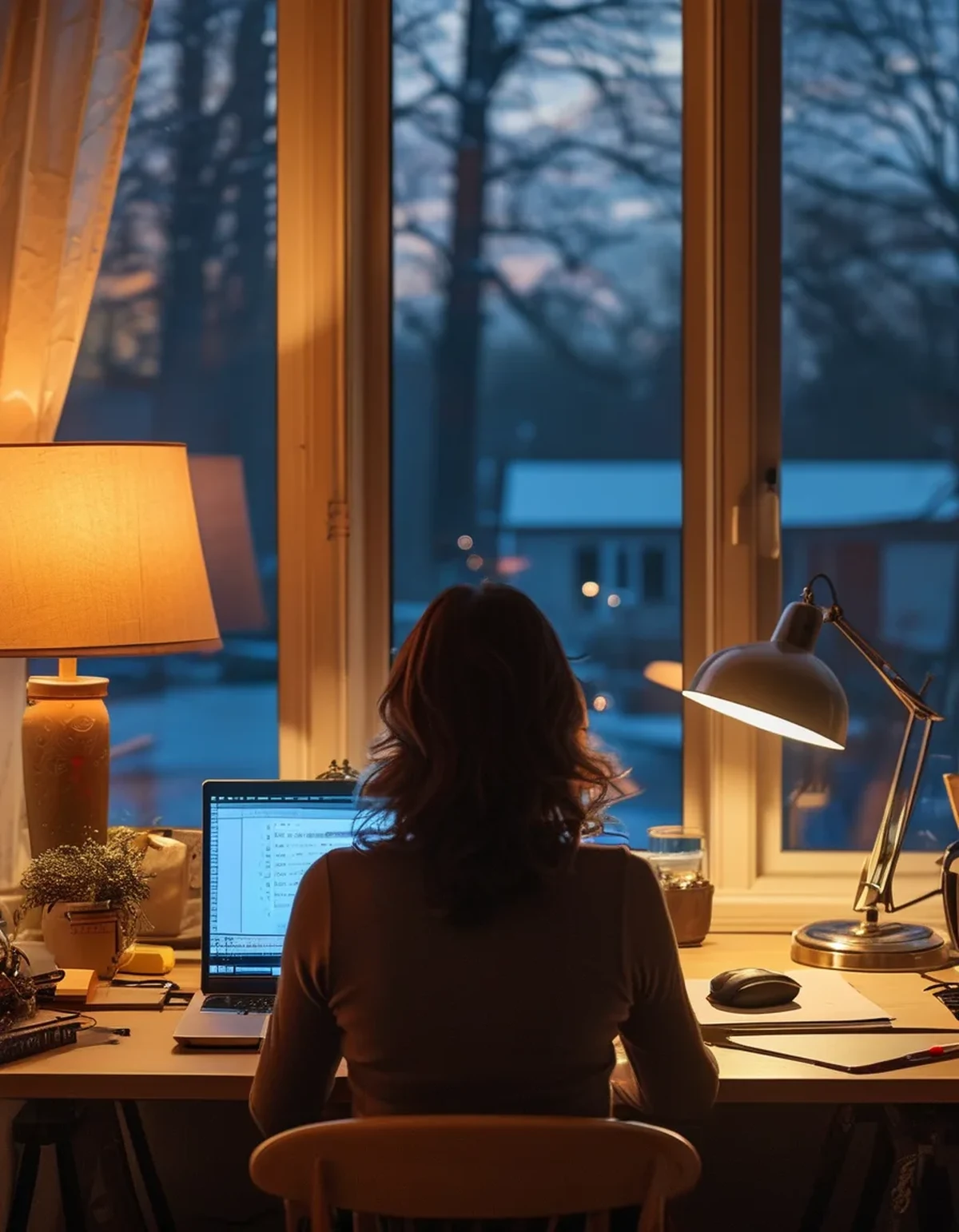
There is also a seasonal factor worth naming right now. As it gets dark earlier in fall, the environmental cue that used to mark evening disappears — you no longer notice that it got late, because it was already dark at 5. This is one reason many people’s hours quietly extend from October onward.

What actually works?
Manufacture the transition. That is the whole strategy, and everything below is a version of it.
Build a shutdown sequence. The same five or six actions in the same order, every day: review tomorrow’s calendar, write the three things for tomorrow, close every tab, put the laptop away, and say something out loud that means finished. Sounds silly, works reliably — the sequence becomes the signal your day is missing.
Put the laptop out of sight. A drawer, a cupboard, a bag. Not closed on the desk. Visible work equipment is a persistent invitation, and the effort of retrieving it is exactly enough friction to make the 9pm check a real decision.
Take a fake commute. A fifteen-minute walk at the end of the day reproduces the transition almost completely — physical movement, time between, arriving home. It is the single most effective intervention people report, and it does not depend on anyone else cooperating.
Change something physical. Clothes, lighting, the room. Turn off the desk lamp. If you work in a multi-purpose room, changing the lighting is a surprisingly strong cue that the space has changed function.
Set a visible hard stop. A recurring calendar block at the end of the day, and where possible, an event immediately after — a class, a call with a friend, dinner with someone. External commitments are the most reliable enforcement mechanism there is.
Silence notifications on schedule, not by willpower. Set them to sleep automatically at a fixed time on both laptop and phone. Deciding not to look, repeatedly, all evening, is a losing strategy.
Turn on a light before it gets dark. Small, and it addresses the fall-specific version of this problem directly — you notice the time passing when the room does not go dim around you.
5 Mistakes That Keep the Day Open
1. Working where you relax. A laptop on the sofa makes the sofa a work location and, more damagingly, makes the workspace a place you also relax. Separation of spaces does what separation of buildings used to.
2. Keeping work apps on your phone. The phone is the main leak. If email and chat are on it, you have not finished the day, you have just moved to a smaller screen. Remove them or set them to a schedule.
3. Treating a hard stop as a soft goal. A stop time that moves when things are busy is not a boundary. It has to hold on the days it is inconvenient, which are the only days it matters.
4. Trying to stop without a sequence. Just closing the laptop leaves the day’s open loops running in your head. The shutdown routine works partly because writing tomorrow’s list lets you stop rehearsing it.
5. Assuming your team expects it. Most people substantially overestimate the availability expected of them. It is worth actually asking — the answer usually removes a lot of self-imposed pressure.
FAQ: Work From Home Boundary Questions, Answered
What if my job genuinely requires evening availability?
Then define which evenings and which channels, rather than being available for everything all the time. Named on-call windows are far less draining than permanent low-level availability.
Does the shutdown routine actually work, or is it just ritual?
It is a ritual, and that is why it works. The commute was also just a ritual with a transport component. Consistency and completion are what carry the signal, not the specific actions.
How long before it feels natural?
Most people report a couple of weeks of it feeling artificial, then it becoming automatic. The fake commute is usually the fastest to stick because it is physically distinct.
I live in a small apartment with no separate space. What then?
Use time and lighting instead of space. A desk lamp that goes off, a table that gets cleared, a chair that gets moved. The cue matters more than the square footage.
Is working more hours from home actually a problem?
Longer hours correlate with worse recovery and higher burnout risk, and evening work in particular interferes with sleep quality. The hours are also frequently low-value — the 9pm check rarely produces much. This is general information, not medical advice.
TL;DR:
- The commute supplied four things — a hard boundary, a transition period, spatial separation, and social closure — and remote work removes all of them.
- Work expands because tasks have no natural end, availability creates expectation, and visible availability substitutes for confidence.
- Manufacture a transition: a fixed shutdown sequence, the laptop out of sight, and a fifteen-minute fake commute.
- Schedule notification silence rather than relying on willpower, and put a real commitment right after your stop time.
- Turn a lamp on before dusk — in fall, losing the light is what quietly stretches the day.
Nobody asked you to work until 10. The thing that used to tell you it was over just stopped existing.
Keep Reading
This article is for general informational and styling purposes only. Fit, sizing, and product availability may vary.