Why Skipping the Commute When Working From Home Removes a Mental Transition Most People Don't Replace
Working from home removes the commute that used to bookend a work day, and while losing that time in traffic feels like a pure win, the commute was also quietly doing psychological work — creating a clear mental transition between work mode and home mode that most WFH routines never actually replace.

Why the Commute Functioned as an Unintentional Buffer Between Work and Home Mindsets
The transition-function mechanism: the a-commute-provided-a-fixed-block-of-time-and-physical-movement-between-the-office-environment-and-the-home-environment (the a built-in spatial and temporal separation that closing a laptop at home doesn’t recreate — the commute-provided-spatial-temporal-separation), the the-that-transition-time-allowed-work-related-thoughts-to-naturally-decompress-before-arriving-home (the a passive but real mental decompression window that simply doesn’t exist when work and home occupy the same physical space — the transition-time-allowed-natural-decompression), the the-without-that-buffer-work-related-thoughts-and-stress-can-carry-directly-into-the-evening-with-no-natural-interruption (the the absence of any separating ritual meaning work mode can bleed straight into personal time — the no-buffer-means-work-mode-bleeds-into-evening), and the reframe (the commute having done real, if unintentional, psychological work that simply disappearing from the day leaves unaddressed rather than automatically solved)).

The Specific Substitute Ritual That Recreates That Transition
The actual substitute: the take-a-short-walk-around-the-block-immediately-after-the-final-work-task-of-the-day (the recreating the physical movement and time-based separation the commute used to provide — the short-walk-after-final-work-task), the the-change-clothes-or-do-some-other-physical-signal-that-marks-the-end-of-the-work-day-specifically (the a deliberate physical cue substituting for the environmental change a commute used to provide automatically — the change-clothes-as-physical-end-of-day-signal), the the-do-a-brief-closing-ritual-like-writing-tomorrows-first-task-before-fully-stepping-away-from-work-space (the giving the mind a specific closing point rather than an ambiguous, open-ended stopping moment — the closing-ritual-like-writing-tomorrows-task), and the frame (a short walk, a physical change-of-clothes cue, and a brief closing ritual — three concrete substitutes that recreate the separating function a commute used to provide automatically).
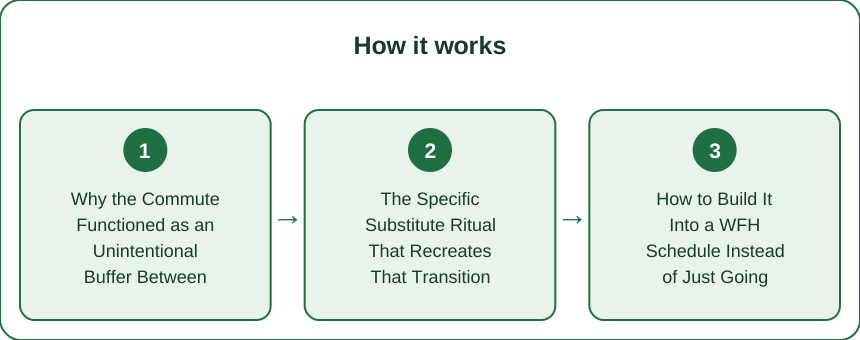
How to Build It Into a WFH Schedule Instead of Just Going Straight From the Last Work Task to the Evening
The practical scheduling approach: the block-a-specific-ten-to-fifteen-minute-slot-immediately-after-the-planned-end-of-workday-for-the-substitute-ritual (the treating the transition as a scheduled part of the day rather than something to do only if there’s time left over — the block-specific-slot-for-transition-ritual), the the-treat-that-block-as-non-negotiable-the-same-way-a-real-commute-couldnt-be-skipped (the giving the substitute the same protected status the original commute had by simply existing as a fixed part of the day — the treat-block-as-non-negotiable-like-real-commute), the the-notice-whether-work-related-thoughts-actually-decrease-after-a-few-weeks-of-consistent-use-and-adjust-the-ritual-if-not (the treating the specific substitute as testable and adjustable rather than assuming any ritual automatically works — the test-and-adjust-ritual-based-on-actual-effect), and the frame (blocking a specific ten to fifteen minute slot right after the workday ends, treating it as non-negotiable, and adjusting the ritual if it doesn’t actually reduce carried-over work thoughts after a few weeks — building the substitute directly into the schedule rather than hoping it happens spontaneously).
Working from home removes the commute that used to bookend a work day, but that commute also quietly provided a fixed block of time and physical movement that separated the office environment from the home environment, letting work-related thoughts naturally decompress before arriving home — without that buffer, work stress can carry directly into the evening with no natural interruption. The substitute that recreates it is a short walk around the block immediately after the final work task, a deliberate physical cue like changing clothes to mark the end of the work day, and a brief closing ritual like writing down tomorrow’s first task before stepping away from the workspace. Build it into a WFH schedule by blocking a specific ten to fifteen minute slot right after the planned end of the workday for that ritual, treating it as non-negotiable the same way an actual commute couldn’t be skipped, and adjusting the specific ritual if work-related thoughts don’t actually decrease after a few consistent weeks of using it.
Keep Reading
This article is for general informational and styling purposes only. Fit, sizing, and product availability may vary.