How to Actually Recover From a Back-to-Back Meeting Day Working From Home
Quick Answer: A meeting-stacked day causes a specific combination of physical stillness fatigue and cognitive social-processing fatigue — recovering from it works best with physical movement first (not more sitting), followed by a genuinely screen-free decompression window before switching to evening tasks.
You didn’t do anything physically demanding today, and yet you’re wiped out by 5pm. Six hours of video calls does something regular desk work doesn’t, and it needs its own recovery approach.

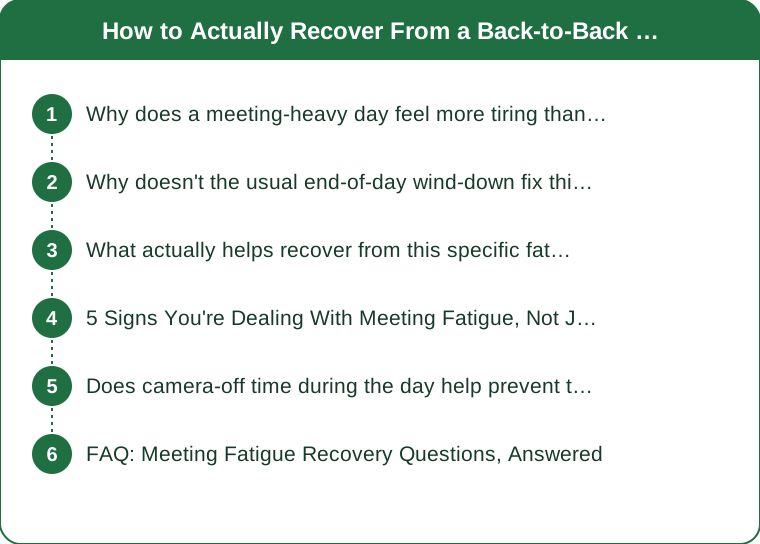
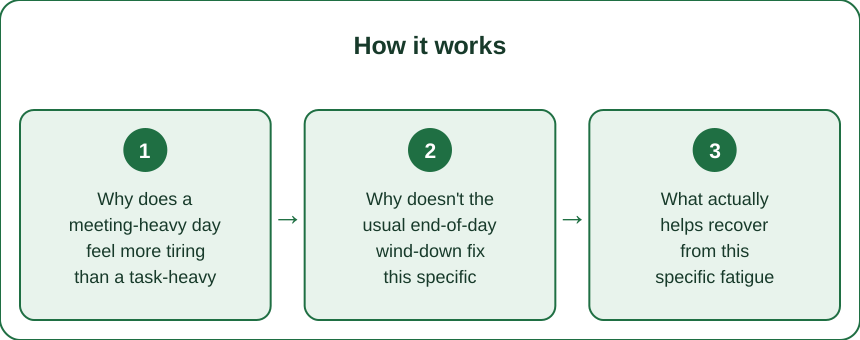
Why does a meeting-heavy day feel more tiring than a task-heavy one?
Video calls require continuous social and cognitive processing — reading facial expressions on a screen, managing your own on-camera presence, and processing conversation in real time without the natural pauses in-person meetings have. This is sometimes called Zoom fatigue, and research on video call cognitive load suggests it’s a real, measurable phenomenon distinct from regular task fatigue.
Compounding this, meeting days usually mean far less physical movement than task-focused days that naturally include getting up, walking to grab something, or shifting position — so you’re accumulating both cognitive fatigue and physical stiffness simultaneously.
Why doesn’t the usual end-of-day wind-down fix this specific fatigue?
Many people’s default wind-down (scrolling a phone, watching something) keeps the screen-based, low-movement pattern going, which doesn’t address either fatigue source from the day. It offers passive rest but not the specific recovery a meeting-heavy day actually needs — physical movement to counter stillness, and a genuine break from screen-based social processing.
What actually helps recover from this specific fatigue type?
Physical movement immediately after the last call — even a 10-15 minute walk — counters the stillness accumulation directly and has research support for reducing the subjective fatigue of a screen-heavy day. Following that with a deliberately screen-free window (even 20-30 minutes) before moving to evening screen time again gives the cognitive social-processing system an actual break rather than just switching to different screen content.

5 Signs You’re Dealing With Meeting Fatigue, Not Just Being Tired
Feeling mentally foggy despite not doing physically demanding work. This points to cognitive rather than physical fatigue.
Wanting to avoid any more talking or social interaction after work. Social battery depletion is a specific marker of meeting-heavy fatigue.
Physical stiffness in the neck, shoulders, or lower back from prolonged stillness. This is the physical half of the same problem.
Feeling more tired on meeting-heavy days than on physically active work days. A clear sign the fatigue source is cognitive/social, not physical exertion.
Difficulty transitioning into focused solo work after a string of calls. The mental gear-shift itself takes measurable recovery time.
Does camera-off time during the day help prevent this fatigue?
For calls where it’s appropriate, yes — reducing camera-on time even for a portion of a meeting-heavy day measurably reduces the self-monitoring cognitive load that contributes to video call fatigue specifically. This isn’t always possible depending on workplace culture, but where it is an option, it’s one of the more effective preventive steps rather than just a recovery one.
FAQ: Meeting Fatigue Recovery Questions, Answered
How long should the screen-free decompression window actually be?
Even 15-20 minutes provides a measurable reset; longer isn’t necessarily better, consistency in taking it at all matters more than optimizing exact duration.
Does this fatigue type build up across the week, or reset daily?
It can compound across a week of consecutive meeting-heavy days without adequate recovery windows, which is part of why proactive daily recovery matters more than treating it as a one-off issue.
Is exercise later in the evening as effective as movement right after the last call?
Immediate movement tends to work better for this specific fatigue type, since it interrupts the stillness pattern at its peak rather than after further passive recovery time has already passed.
TL;DR:
- Meeting-heavy days combine cognitive social-processing fatigue with physical stillness fatigue
- Passive screen-based wind-downs don’t address either fatigue source
- Movement right after the last call, then a genuine screen-free window, works better
- Reducing camera-on time when possible helps prevent the fatigue, not just recover from it
The exhaustion after a meeting-stacked day is real and specific — it just needs a different recovery approach than the one that works after a regular task-focused day.
Keep Reading
This article is for general informational and styling purposes only. Fit, sizing, and product availability may vary.