Darker Mornings Are Coming for Your Home Working Day
Quick Answer: Morning light is the primary signal that sets your body clock, and it is the signal that drops fastest as autumn progresses. Working from home removes the commute that used to deliver it, so home workers lose more light than office workers do. Get outside early, even briefly, and raise your indoor light levels in the morning. The commute was doing more than transport.
The office worker still walks to a station in the dark.
The home worker goes from bed to desk without crossing a threshold, which is a bigger loss than it sounds.
Why does losing morning light matter so much?
Because it is the main input your body clock uses to know what time it is.
Light exposure in the morning anchors your circadian rhythm. Without a consistent bright signal early in the day, sleep timing drifts later and alertness in the morning drops. The anchor is light, not the alarm clock, which is why waking at the same time in a dark room does not fully substitute.
Indoor lighting is far dimmer than outdoors. Even a bright-feeling room is typically an order of magnitude less intense than an overcast day outside. A well-lit home office does not count as light exposure in the sense your body clock cares about.
Home workers lose disproportionately. A commute, even a short walk to a bus stop, delivers meaningful outdoor exposure at exactly the right time of day. Removing the commute removed the light, and nothing replaced it.
The drop compounds through autumn. Each week, sunrise arrives later, and there comes a point where you start work before it is properly light. The effect accelerates rather than arriving gradually.
It shows up as afternoon slump and evening restlessness. A poorly anchored clock produces low morning alertness, an exaggerated afternoon dip, and difficulty settling in the evening. All three are the same problem wearing different clothes.
And mood is affected for many people. Seasonal changes in mood and energy are common as daylight shortens. Persistent low mood, not just low energy, is worth discussing with a doctor rather than pushing through. This is general information, not medical advice.
What actually replaces the commute?
A short, deliberate outdoor block, protected the way a meeting would be.
Ten to fifteen minutes outside within an hour of waking. Not looking out a window - actually outside, where the light is dramatically brighter even on a grey day. This is the single highest-value change in this article by a wide margin.
It does not need to be exercise. A walk around the block, standing on a doorstep with coffee, or taking a call outside all count. Presence outdoors is the mechanism, not the activity.
Grey days still work. An overcast morning outdoors remains far brighter than a lit room indoors, which is the point people find hardest to believe. Do not skip it because it looks dull - that is precisely when it matters.
Put it in the calendar as a real block. Anything unscheduled loses to the first email of the day, and this in particular. Treat it like a meeting for the first few weeks until it holds on its own.
Attach it to something you already do. Coffee, the first call, or walking the dog - habits stick far better when anchored to an existing one. A new standalone habit in November rarely survives.
And keep it on weekends. The clock does not distinguish between Tuesday and Saturday, and two days of drift undoes several days of consistency. Weekend consistency is where most resets fail.
What can you change about the room itself?
Indoor light cannot replace outdoors, but it helps considerably.
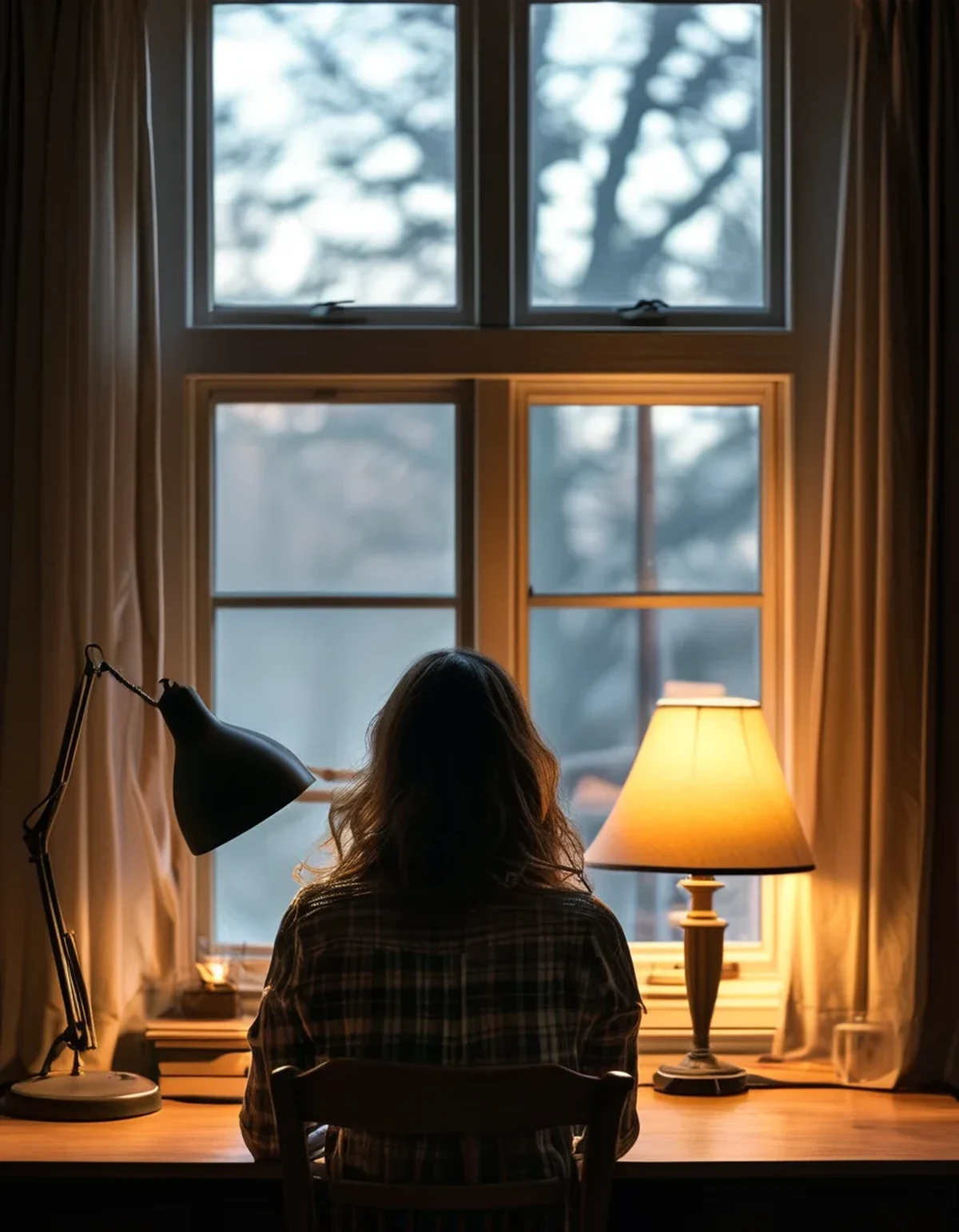
Make the morning workspace brighter than the evening one. Bright, cooler light in the morning and dimmer, warmer light in the evening reinforces the day-night pattern. Most home offices are lit identically all day, which flattens the signal entirely.
Sit facing or near the window. Position matters more than people think - light falls off sharply with distance from the source. A desk moved a few feet closer to a window changes your exposure meaningfully.
Consider a bright light unit for the darkest months. Purpose-built daylight lamps are used specifically for this, and for many people they help with winter mornings. Worth discussing with a doctor if your low mood is significant rather than mild.
Dim the evening deliberately. Bright light late pushes your clock later and undoes the morning’s work. Lamps instead of overheads after dinner is a small change with a real effect.
Watch the screen glare shift. As the sun sits lower, autumn light comes in at angles that create glare that did not exist in summer. The same desk position can become uncomfortable in October without anything moving.
And keep a fixed wake time. Light does most of the work, but a consistent wake time is what lets it. Fixed wake, morning light, dim evenings - that is the entire protocol and it costs nothing.
What Nobody Tells You About Working From Home in Autumn
The commute was doing four jobs. Transport, light exposure, a psychological transition, and incidental movement. Removing it removed all four, and most people only replaced the transport.
The slump arrives before the clocks change. Sunrise shifts gradually from late August onward, so the effect builds well before the obvious calendar event. People blame the clock change for something that started six weeks earlier.
Afternoon energy is decided in the morning. The three o’clock dip is exaggerated by a poorly anchored clock, and no amount of afternoon coffee fixes a morning light problem. You cannot caffeinate your way out of it.
Working near a window is not the same as going outside. Glass reduces intensity substantially, and indoor levels remain far below outdoor ones. The window seat is a consolation, not a solution.
Home workers often see fewer people as well as less light. Autumn reduces incidental social contact alongside daylight, and the two together do more than either alone. Scheduling contact matters more in winter, not less.
And the fix is unglamorous. Fifteen minutes outside, a fixed wake time, and dimmer evenings. It is not a productivity system, which is probably why it gets skipped in favour of one.
FAQ: Autumn Home Working Questions, Answered
How long outside is actually enough?
Ten to fifteen minutes within an hour of waking suits most people, and more is better on very dull days. Consistency beats duration - every morning for ten minutes outperforms an hour on Sundays.
Do daylight lamps work?
Many people find them helpful for dark mornings, and they are widely used for exactly this. They are a supplement to going outside, not a replacement, and worth raising with a doctor if your symptoms are significant.
Why am I tired at three every afternoon now?
A post-lunch dip is normal, and a weakly anchored body clock exaggerates it. Morning light and a short outdoor break at lunch address it far more effectively than caffeine does.
TL;DR:
- Morning light anchors your body clock, and home working removed the commute that used to supply it.
- Indoor lighting is dramatically dimmer than outdoors - a bright room does not count.
- Ten to fifteen minutes outside within an hour of waking is the highest-value change available.
- Grey days still work, and weekends count - two days of drift undoes a week of consistency.
- Brighter mornings and dimmer evenings indoors reinforce what the outdoor block starts.
Put a fifteen-minute outdoor block in tomorrow’s calendar before your first meeting. It is the commute you deleted, and it was doing more than you thought.
Keep Reading
This article is for general informational and styling purposes only. Fit, sizing, and product availability may vary.