Do Desk Plants Actually Improve Air Quality in a Home Office, or Is That a Myth?
Quick Answer: The often-cited NASA study did find plants can remove certain airborne toxins, but it was conducted in sealed lab chambers with far more plants per square foot than a typical desk setup — a couple of desk plants provide a modest, real but limited air quality benefit, not the dramatic effect the study is often used to suggest.

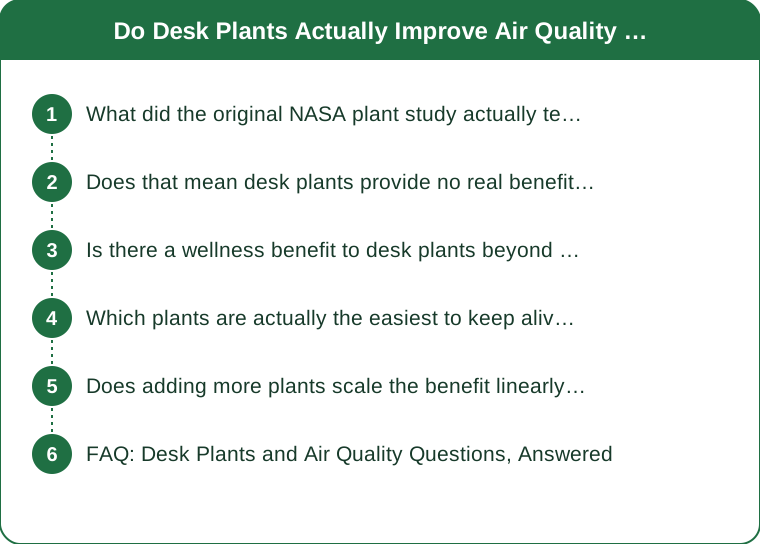
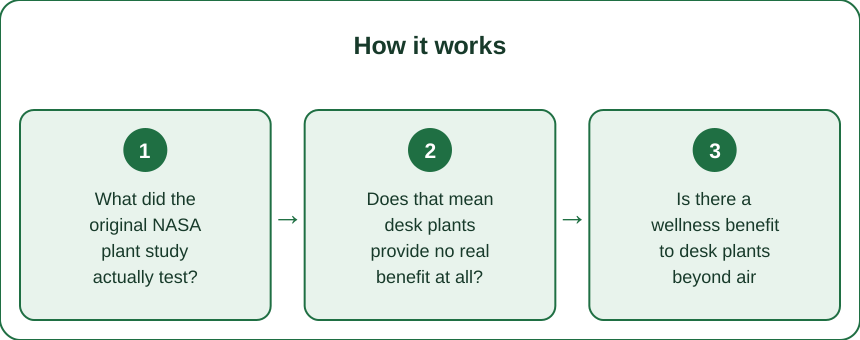
What did the original NASA plant study actually test?
The 1989 NASA Clean Air Study tested how effectively various houseplants removed specific volatile organic compounds (like formaldehyde and benzene) from sealed, controlled chambers, finding measurable removal rates for several common plant species. It’s genuinely useful foundational research — the issue is almost entirely in how it’s since been extrapolated to open, real-world rooms with normal airflow, which behave very differently from a sealed lab chamber.
Does that mean desk plants provide no real benefit at all?
Not none — just more modest than the popular version of the claim suggests. A couple of plants on or near a desk in a normally ventilated room contribute a small, measurable air quality benefit, but achieving the dramatic effects sometimes cited would require a plant density far higher than almost anyone actually has in a real home office. The benefit is real but proportionally smaller than the marketing-friendly version of the NASA study implies.
Is there a wellness benefit to desk plants beyond air quality specifically?
Genuinely, yes, and arguably a bigger one than the air quality effect. Visual exposure to greenery has documented associations with reduced stress and improved mood and focus in office and home-office settings, separate from any measurable air chemistry change. For most people, this psychological and aesthetic benefit is a more reliably significant reason to keep desk plants than air purification specifically.

Which plants are actually the easiest to keep alive in a typical desk setup?
Pothos, snake plants, and ZZ plants are commonly recommended specifically for low-light, low-maintenance desk environments, since they tolerate inconsistent watering and limited natural light better than many other common houseplants. Choosing an easy-to-maintain plant matters more for actually getting any benefit than choosing a species based purely on air-purification study rankings, since a plant that dies from neglect provides no benefit at all.
Does adding more plants scale the benefit linearly, or is there a point of diminishing returns?
For meaningful air quality change specifically, you would need a plant density well beyond what’s practical for a typical desk or even a full room to approach lab-study effect sizes — so from a pure air-chemistry standpoint, returns diminish quickly relative to how many plants most people would realistically want in a workspace. From a mood and aesthetic standpoint, the returns are more subjective and continue to feel worthwhile to many people well past the point where air quality gains would have leveled off.
FAQ: Desk Plants and Air Quality Questions, Answered
How many plants would actually be needed for a noticeable air quality effect?
Estimates based on scaling the original study suggest a much higher density than typical — often cited as many plants per room rather than one or two on a desk — to approach measurable real-world air quality change.
Are air-purifying plants worth it if air quality isn’t the main goal?
Yes, for many people — the stress-reduction and mood benefits of having plants nearby are well supported independently of the air quality question.
Do larger plants provide meaningfully more benefit than several small desk plants?
Generally, more total leaf surface area (whether from one larger plant or several smaller ones) is what matters for any air quality effect, so it’s more about total plant mass than plant count specifically.
TL;DR:
- The NASA study’s dramatic results came from sealed lab chambers, not real rooms with normal airflow
- A couple of desk plants provide a modest, genuine air quality benefit, not a dramatic one
- The stress-reduction and mood benefits of visible greenery are a more reliably significant reason to keep them
- Easy-care species like pothos and snake plants matter more practically than air-purification rankings
Desk plants are worth having for how they make a home office feel, more than for measurably cleaner air — and that’s a genuinely good enough reason on its own.
Keep Reading
This article is for general informational and styling purposes only. Fit, sizing, and product availability may vary.