Why Working in Complete Silence Is More Tiring Than the Office Was
Quick Answer: Total silence is not neutral — in a very quiet room, small unpredictable sounds stand out sharply and repeatedly trigger an orienting response, which is more disruptive than a constant background level. Silence also removes the ambient social and temporal cues that structure an office day, so nothing marks the passage of time or the transition between tasks. Steady, low-level background sound at a modest volume usually improves both comfort and concentration.
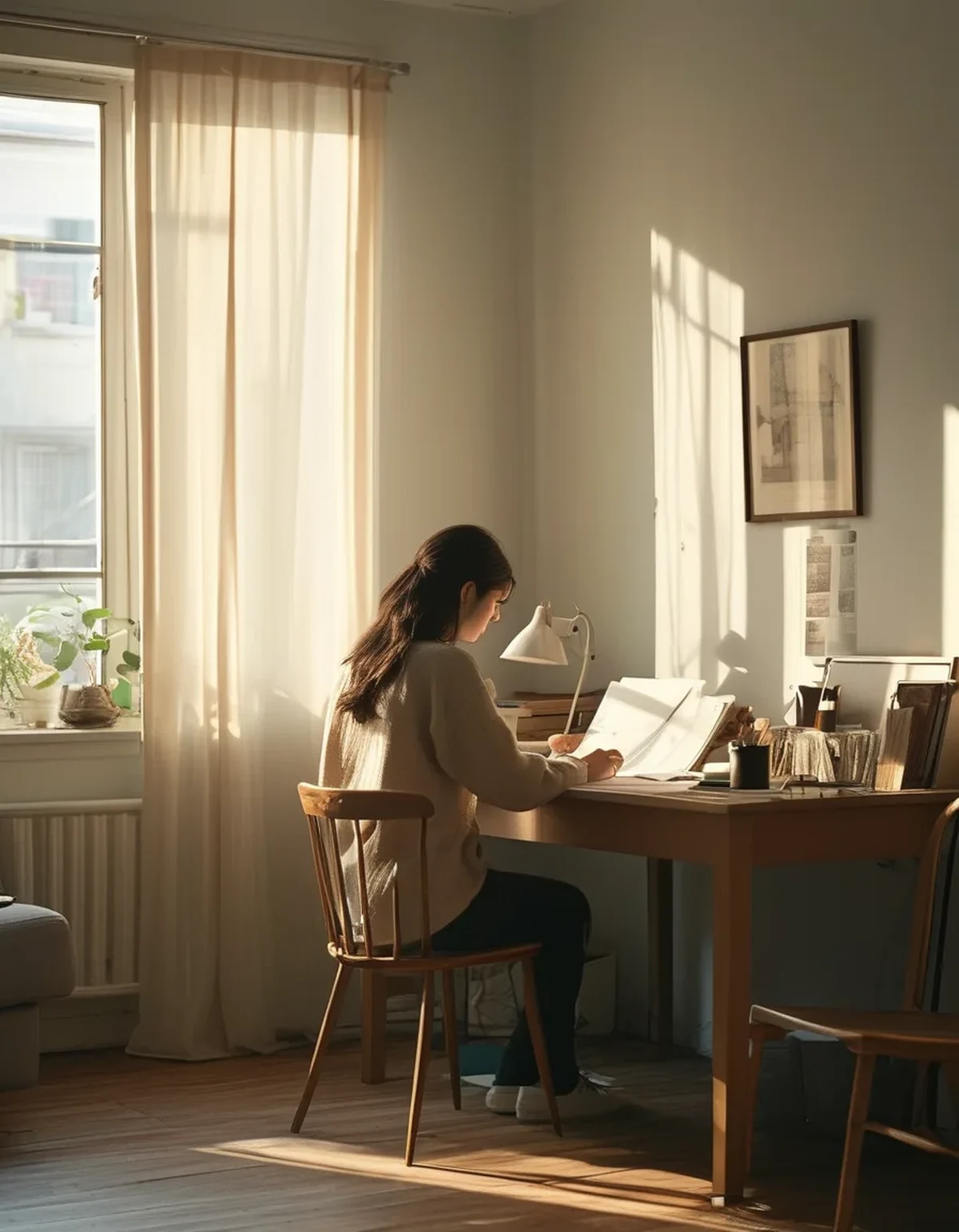
A quiet room is not a calm room. It is a room where every noise is an event.
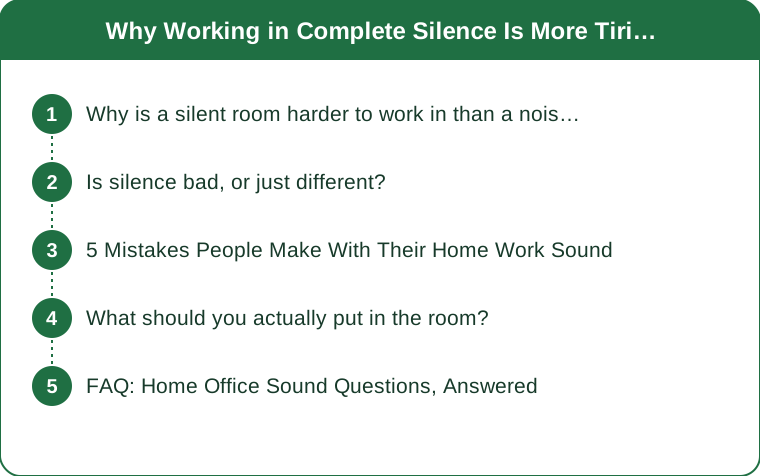
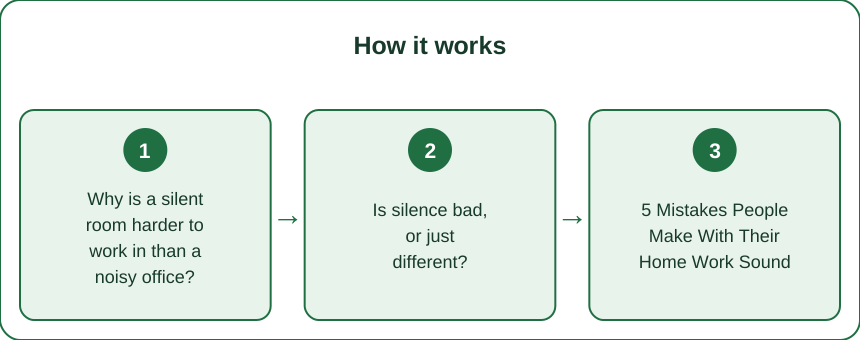
Why is a silent room harder to work in than a noisy office?
Because contrast, not volume, is what breaks concentration.
Unexpected sounds trigger an orienting response — an automatic shift of attention toward a novel stimulus. It is fast, involuntary, and it interrupts whatever you were doing.
In a very quiet room, every small sound is novel. A pipe, a floorboard, a car door, a neighbour’s footsteps. Against near-silence each one stands out sharply and captures attention, and each interruption costs time to recover from.
In a moderately noisy environment, the same sounds are masked. They never rise above the background, so they never register as events. This is why a café with a steady hum can be easier to concentrate in than a silent flat, which surprises people who assume quieter is always better.
Speech is the exception. Intelligible speech is uniquely disruptive to work involving language — reading, writing, anything verbal — because you cannot help processing it. This is why an open-plan office with conversations is genuinely bad, and why café noise works better when you cannot make out individual words.
Silence also removes structure. An office provides ambient cues about time and rhythm: people arriving, a lunchtime lull, the sound of a day winding down. Alone in a silent flat, nothing marks the passage of time, and the day becomes an undifferentiated block.
And it amplifies internal noise. With no external input, attention turns inward — toward rumination, task-unrelated thought, and low-grade worry. For a lot of people this is the actual mechanism behind quiet-room fatigue.
Is silence bad, or just different?
Neither. It depends entirely on the task and the person.
Silence genuinely is best for some work. Complex, demanding tasks requiring working memory — dense reading, difficult analysis, learning something new — are generally done better in quiet.
Moderate background sound suits routine and creative work. For repetitive tasks, admin, and some kinds of idea generation, a moderate ambient level appears to be no worse and sometimes better than silence.
Individual variation is large. People differ considerably in how much noise they tolerate, and more distractible individuals are affected more strongly by background sound during demanding tasks — so the right answer really does vary between people.
Music with lyrics behaves like speech. For anything involving language, lyrics compete for the same processing resources. Instrumental music does not, which is why so many people converge on it independently.
Familiar beats novel. A playlist you know well demands less attention than one you have never heard, and novel music is a distraction in its own right.
Which means the useful question is not silent or not. It is: what does this specific task need, right now? Deep work in the morning may want silence; the admin block after lunch may want a podcast.
And the physiological effect is real either way. Chronic noise exposure is genuinely harmful and associated with stress responses. The point is not that noise is good — it is that a moderate, steady, predictable background is different from both loud noise and total silence.

5 Mistakes People Make With Their Home Work Sound
1. Assuming quieter is always better. Removing all sound removes masking, and every remaining small noise becomes an interruption. A low, steady background is often more comfortable than none.
2. Using music with lyrics for writing. Language competes with language. If your work involves words, instrumental or ambient sound is measurably less disruptive.
3. Wearing noise-cancelling headphones with nothing playing, all day. Full acoustic isolation for eight hours produces exactly the silent-room problem, plus a physical pressure sensation many people find fatiguing. Take them off between blocks.
4. Turning the volume up to mask a specific noise. Loud masking is its own stress. Lower, broader background sound masks better than louder, narrower sound, and protects your hearing.
5. Using the same sound environment all day. The needs of deep work, admin, and calls are different. Matching sound to task is a five-second change that most people never make.
What should you actually put in the room?
Something steady, something structural, and something that ends the day.
Steady ambient sound is the default. Brown or pink noise, rain, or a fan — anything constant and featureless. It masks intermittent sounds without demanding attention.
Instrumental music for focus blocks. Familiar, without lyrics, at a volume you can talk over.
Café or ambient recordings work well for many people, and the effective ingredient is a mix of unintelligible voices and general hum rather than the café specifically.
Silence, deliberately, for the hardest hour. Reserve genuine quiet for the most demanding cognitive work rather than defaulting to it all day.
Then use sound to rebuild the structure the office provided:
A different sound for each block of the day. Ambient for morning deep work, music for admin, a podcast for routine tasks. The change itself signals a transition, which is what an office provided for free.
A sound that marks the end of the workday. A specific album, a radio programme, a playlist that only plays after work. This is one of the more effective boundary rituals for people whose work and home are the same room.
Get real sound from outside the house too. Silence-driven fatigue is often actually isolation-driven fatigue wearing a different hat. A walk with other humans in earshot, a call, a co-working session once a week.
The autumn version matters. As the weather cools, windows close, outdoor sound disappears, and home offices get considerably quieter — while daylight shrinks at the same time. Both of the day’s structuring cues weaken together, which is why late autumn is when home working feels flattest. Deliberate sound and deliberate light both belong in the same conversation.
This is general guidance rather than medical advice. Persistent fatigue, low mood, or ringing in the ears is worth discussing with a doctor.
FAQ: Home Office Sound Questions, Answered
Why does a café help me concentrate more than my quiet flat?
Because a steady background hum masks the intermittent sounds that would otherwise capture your attention, and café voices are usually unintelligible enough not to compete with language processing.
Is background music bad for focus?
It depends on the task and the music. Lyrics compete with any work involving language; familiar instrumental music generally does not, and for routine work a moderate background often helps.
Should I wear noise-cancelling headphones all day?
Probably not with nothing playing. Full isolation for hours recreates the silent-room problem and many people find the sensation fatiguing. Use them for specific blocks and take them off between.
What is the best background sound for deep work?
For genuinely demanding tasks, quiet or very low steady ambient sound like brown noise or rain. Save music and podcasts for admin and routine work where they cost you less.
TL;DR:
- In near-silence, small sounds become events that trigger an orienting response, so quiet rooms interrupt more than steady background sound does.
- Speech and lyrics compete with language work specifically; instrumental and unintelligible ambient sound do not.
- Silence suits the hardest cognitive work; moderate background suits routine and creative tasks — match sound to task rather than picking one.
- Sound can rebuild the structure an office gave you, including a specific sound that marks the end of the day.
Put brown noise on at low volume tomorrow morning and see what happens by lunch. It is a thirty-second experiment.
Keep Reading
This article is for general informational and styling purposes only. Fit, sizing, and product availability may vary.