The End-of-Workday Ritual That Actually Helps You Mentally Clock Out at Home
Quick Answer: A short, consistent physical ritual — closing the laptop, changing clothes, and a 10-minute walk or task unrelated to work — recreates the psychological transition a commute used to provide, and is one of the most effective fixes for WFH days that never really end.
The commute wasn’t just travel time — it was a built-in buffer between ‘working’ and ‘not working.’ Without it, work quietly seeps into dinner, into the evening, into everything.

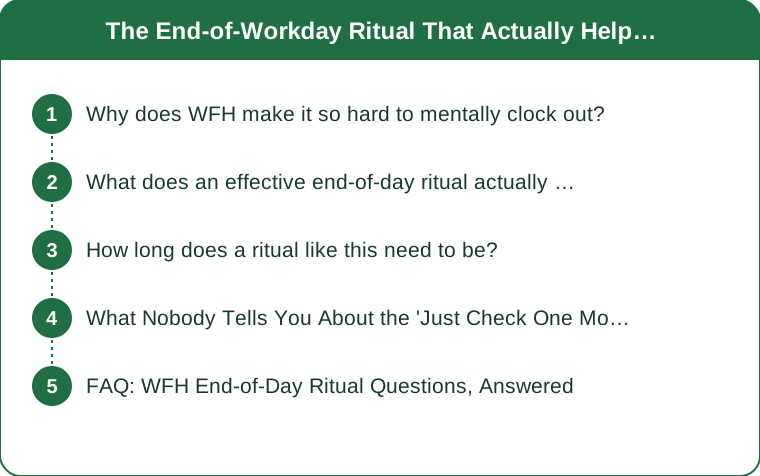
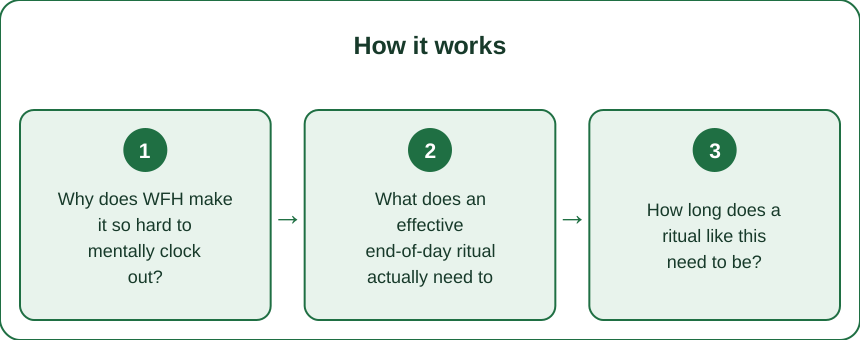
Why does WFH make it so hard to mentally clock out?
Because the physical and psychological cues that used to signal ‘work is over’ disappeared along with the commute. Same room, same chair, same screen — your brain doesn’t get the environmental signal that a transition happened, so work-mode just continues by default.
What does an effective end-of-day ritual actually need to include?
A physical action, not just a mental decision. Closing the laptop lid, changing out of ‘work clothes’ even if that’s just a hoodie swap, and physically leaving the workspace for at least 10 minutes are the three elements that show up most consistently in what actually works for people.

How long does a ritual like this need to be?
10-15 minutes is enough — this isn’t about a long elaborate routine, it’s about a clear enough physical transition that your brain registers a boundary. A short walk around the block, a few minutes of stretching, or even just making tea in a different room all serve this purpose.
What Nobody Tells You About the ‘Just Check One More Email’ Trap
The ritual only works if it happens before you check that one more notification, not after. Once you’ve reopened your laptop ‘just for a second,’ the transition boundary resets, and most people find themselves back in work mode for another 20-30 minutes minimum. Close the laptop first, then decide if anything is truly urgent — almost nothing actually is.
FAQ: WFH End-of-Day Ritual Questions, Answered
What if my job requires me to be reachable after hours?
A ritual still helps — the goal isn’t total disconnection, it’s a clear mental marker between ‘default work mode’ and ‘available if truly needed,’ which reduces the low-grade always-on feeling even if you’re technically still reachable.
Does the ritual need to be the same every day?
Consistency helps your brain build the association faster, but the specific activity can vary — what matters is that it’s a deliberate physical action, not the exact content of it.
How long until this actually starts feeling automatic?
Most people report the transition starting to feel natural after about 2-3 weeks of consistent practice — the habit-forming period is similar to most other daily routine changes.
TL;DR:
- WFH removes the commute’s natural transition cue, so work quietly bleeds into evenings
- An effective ritual needs a physical action — closing the laptop, changing clothes, a short walk
- 10-15 minutes is enough; this isn’t about an elaborate routine
- Do the ritual before checking ‘just one more’ notification, not after — that resets the boundary
Keep Reading
This article is for general informational and styling purposes only. Fit, sizing, and product availability may vary.