Why Video Calls Drain You More Than In-Person Meetings — and the 3 Fixes That Help
Quick Answer: Video calls fatigue you more because your brain works overtime parsing delayed audio, held eye contact with a self-view mirror, and reduced body-language cues — all at once, for the whole call. Turning off self-view, taking audio-only calls when video isn’t essential, and adding a 5-minute buffer between back-to-back calls meaningfully cuts the drain.
You can sit through a 6-hour in-person conference and feel fine, then come out of four 30-minute Zoom calls completely wiped. That’s not weakness — researchers have a name for it, and there are specific mechanisms driving it that in-person meetings simply don’t trigger.

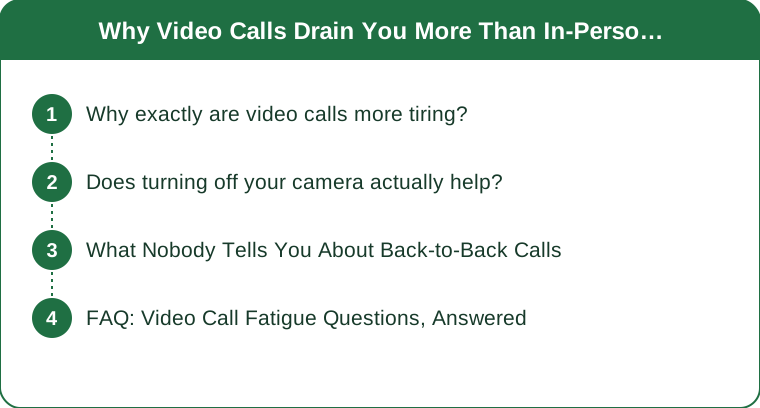
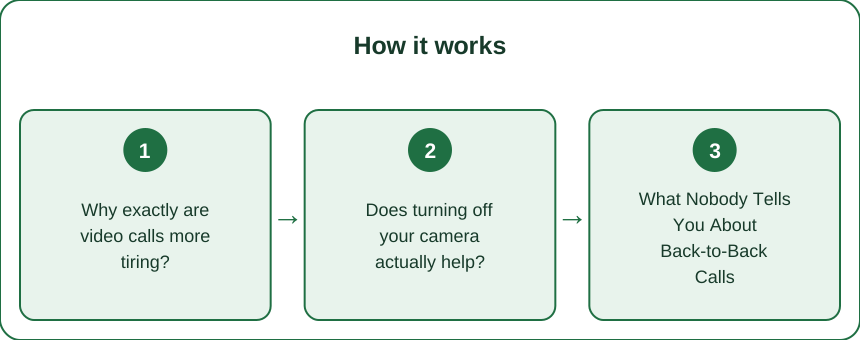
Why exactly are video calls more tiring?
Three things stack up that don’t happen face-to-face. First, audio lag of even 200 milliseconds makes your brain unconsciously judge the other person as less trustworthy or attentive, and it works harder to compensate. Second, you’re staring at a mirror of your own face for the entire call — something that never happens in a real conversation, and it triggers constant low-level self-monitoring. Third, you lose peripheral body language, so your brain leans harder on the small window of the face, which is more effortful to parse.
Stack four or five of these calls back to back and the fatigue compounds — it’s not one big drain, it’s many small cognitive taxes running the whole time.
Does turning off your camera actually help?
Yes, measurably. Studies on video fatigue found that turning off self-view specifically (keeping the call on, hiding your own tile) reduced fatigue more than turning off the camera entirely in some cases, because the self-monitoring loop is the biggest single driver.
Most platforms let you hide your own preview without turning off your camera for others — use that setting by default, and reserve full camera-off for calls where you genuinely don’t need to be seen.

What Nobody Tells You About Back-to-Back Calls
Here’s the part that surprises people: it’s not really the individual calls that wreck you, it’s the zero transition time between them. In an office, walking to a different room resets your brain for 90 seconds. On Zoom, one call ends and the next starts with one click — no reset at all.
The fix is almost embarrassingly simple: block 5-10 minutes between meetings on your own calendar, even if it looks like a gap nobody else has. That short buffer does more for end-of-day fatigue than any lighting or camera trick.
FAQ: Video Call Fatigue Questions, Answered
Is Zoom fatigue a real medical thing?
It’s a recognized, studied phenomenon (sometimes called ‘Zoom fatigue’ in research literature), driven by cognitive load from audio lag, self-view, and reduced nonverbal cues — not an official diagnosis, but a real and measurable effect.
Should every meeting be video?
No — audio-only is genuinely fine for status updates, 1:1 check-ins with people you know well, and any call where visual context adds nothing. Default to video only when it adds real value.
Does a bigger monitor help or hurt fatigue?
A bigger screen with faces at a more natural size can actually help — tiny thumbnail faces force more visual strain than a properly sized display.
TL;DR:
- Audio lag, self-view mirroring, and lost body language stack into real cognitive load
- Hide self-view instead of turning off your whole camera when possible
- Block 5-10 minutes between back-to-back calls — the transition gap matters most
- Default to audio-only when video adds no real value
The fatigue is real and mechanical, not a personal failing — small structural changes fix more of it than willpower does.
Keep Reading
This article is for general informational and styling purposes only. Fit, sizing, and product availability may vary.