What the Commute Was Actually Doing for You
Quick Answer: The commute delivered three things nobody was tracking: a dose of morning outdoor light that anchored the circadian clock, a block of incidental movement, and a psychological transition that separated work from home. Remove it and you get later, less consolidated sleep, a large drop in daily step count, and a workday with no defined end. The replacement does not need to take as long as the commute did - a ten-minute outdoor walk before starting and another at the end covers most of it.
You got 70 minutes a day back and you are more tired than you were.
Which makes no sense until you look at what those 70 minutes were quietly paying for.

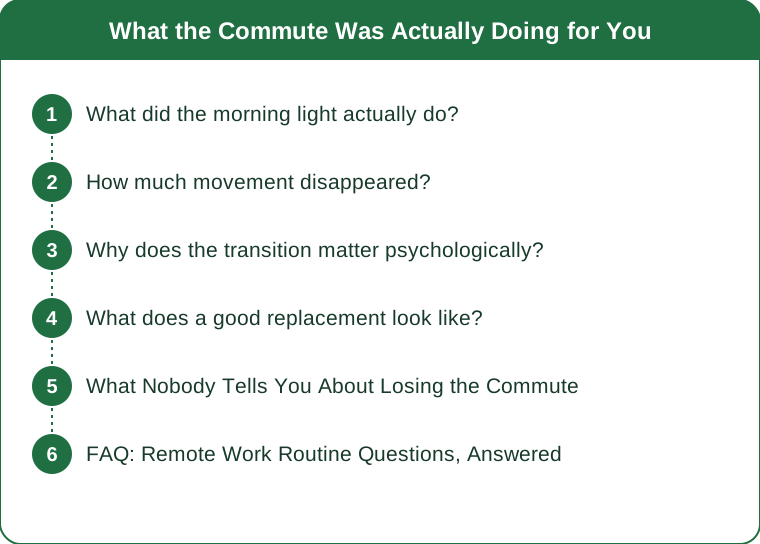
What did the morning light actually do?
Morning outdoor light is the strongest signal your circadian clock receives, and it sets the timing of the whole day including when melatonin rises that night.
Indoor light is dramatically dimmer than outdoors - typically a few hundred lux against several thousand to tens of thousands even on an overcast day.
Sitting by a window is not equivalent, since glass and distance from it cut the intensity substantially.
Without that signal, sleep timing drifts later and becomes less consolidated, which is the mechanism behind the fatigue.
Autumn makes it much worse. Later sunrise and darker mornings mean people who never go out may get no meaningful bright light at all.
Ten to twenty minutes outside within an hour of waking replaces it, and it works on cloudy days too.
How much movement disappeared?
Studies of the shift to remote work consistently show large drops in daily step count, with reductions of thousands of steps being common.
Commuting movement was incidental, which is the reason it was sustainable - it required no motivation and no scheduling.
Incidental activity across a day contributes meaningfully to total energy expenditure, more than most people credit.
Sitting time rises at the same time, so the change is in both directions at once.
A structured workout does not fully replace it, since 45 minutes of exercise and eleven hours of sitting is a different picture from movement spread across a day.
Which is why replacing the commute with a walk works better than replacing it with a gym session, ideally both.
Why does the transition matter psychologically?
The commute was a boundary ritual that marked the shift into and out of work mode.
Without it, work bleeds into the evening, because there is no event that says it has ended.
Physical location cues matter to the brain. Working where you relax weakens both, which is why a dedicated space helps even when it is small.
The end-of-day transition is the more important of the two, since that is where the boundary erosion actually happens.
A short walk at the end of the day works as a decompression ritual and is the most commonly recommended replacement for exactly this reason.
Changing clothes counts too, which sounds trivial and functions as a genuine signal.

What does a good replacement look like?
A ten to twenty minute outdoor walk before starting work, which covers light and movement at once and is the highest-value single habit here.
A second walk at the end of the workday, which handles the transition and adds movement.
Movement breaks every hour - even two minutes - since the commute was not the only thing you lost, workplace walking was too.
A defined start and stop time, written down, since a workday without edges expands.
Work in one place and relax in another where the home allows it, even if that means moving to a different chair.
And keep the walk in autumn and winter specifically, because that is when it is easiest to drop and when the light exposure matters most.
What Nobody Tells You About Losing the Commute
Overcast days still deliver plenty of light. People skip the morning walk in autumn because it looks grey, but a cloudy day outdoors is typically an order of magnitude brighter than a well-lit indoor room. The comparison that matters is outdoor versus indoor, not sunny versus cloudy.
The light needs to reach your eyes, not your skin. Sitting near a window with your back to it, or walking while looking at your phone, delivers far less signal. Looking toward the sky, not at the sun, is what does it.
Evening screens matter more when mornings are dark. A strong morning signal makes the clock more resistant to evening light. Without it, evening screen exposure has a proportionally larger effect on sleep timing, which is why the two problems compound in winter.
The end-of-day transition is more important than the morning one. Most people build a morning routine and never build an evening one, and then wonder why work follows them into the evening. The 6pm walk is the harder habit and the higher-value one.
Step count is not the whole story - it is the distribution. Eleven hours of sitting broken by one gym session is metabolically different from the same total steps spread across the day. Hourly movement breaks are addressing something a workout does not.
And a light therapy lamp is a legitimate substitute when the morning is genuinely dark. In late autumn and winter at higher latitudes, sunrise can arrive after your workday starts. A 10,000 lux lamp for 20 to 30 minutes in the morning is well-evidenced, and it is a reasonable answer when going outside at the right time is not possible.
This is general information, not medical advice.
FAQ: Remote Work Routine Questions, Answered
How long does the morning walk need to be?
Ten to twenty minutes outdoors within an hour of waking covers most of the circadian benefit. Longer is better for the movement side.
Does it work on cloudy days?
Yes. Overcast daylight is still far brighter than indoor lighting, and the effect on the clock is substantial.
Is sitting by a window enough?
Much less effective. Glass reduces intensity and light falls off quickly with distance from the window.
What if it is dark when I start work?
A 10,000 lux light therapy lamp for 20 to 30 minutes in the morning is a well-supported alternative during the dark months.
How do I stop work bleeding into the evening?
A fixed stop time plus an end-of-day walk or a change of clothes. The ritual matters more than its length.
How many movement breaks should I take?
A couple of minutes every hour is a reasonable target and is more effective than one long break.
This is general information, not medical advice.
TL;DR:
- The commute delivered morning outdoor light, incidental movement and a work-home boundary.
- Losing the light drifts sleep later and less consolidated - worst in dark autumn mornings.
- Remote work drops daily step count substantially, and a single workout does not replace distributed movement.
- Replace it with a 10-20 minute outdoor walk before work and another at the end of the day.
- The evening transition is the harder habit to build and the more valuable one.
You got the time back. You just never replaced what it was doing.
Keep Reading
This article is for general informational and styling purposes only. Fit, sizing, and product availability may vary.